Radon Testing in Greensboro — Independent Test, Written Report
A continuous radon monitor placed in your home for at least 48 hours. You get a written report with EPA action-level context. We test only. We do not sell mitigation, so your reading stays independent of any remediation quote.
Continuous radon monitor deployed on the lowest occupied level. 48-hour minimum, closed-house conditions.
02 · WHO PERFORMS YOUR TEST
Owned and led by a Certified Master Inspector
Home Spectors is family-owned and has been serving Greensboro and the Triad since 2007. The company is led by Jason Michael, a Certified Master Inspector (CMI®) and North Carolina Home Inspector Licensure Board licensee — .
Radon testing is performed by an in-house Home Spectors inspector — never subcontracted. The inspector deploys the continuous radon monitor, retrieves it after the test window, and delivers the written report to you.
We have completed more than 40,000 inspections since 2007. Radon testing is an add-on we perform routinely alongside residential home inspections across the Triad.
Radon, in plain English
Radon is a colorless, odorless radioactive gas. It can seep into homes from the ground. Long-term exposure is a known lung-cancer risk (EPA). Testing is the only way to know the level in a specific home. You cannot see it, smell it, or taste it.
Uranium in soil and rock decays into radon gas, which seeps upward into homes through the foundation, cracks, and utility penetrations.
Radon can accumulate in enclosed spaces (basements, first floors) to concentrations that raise long-term lung-cancer risk (EPA).
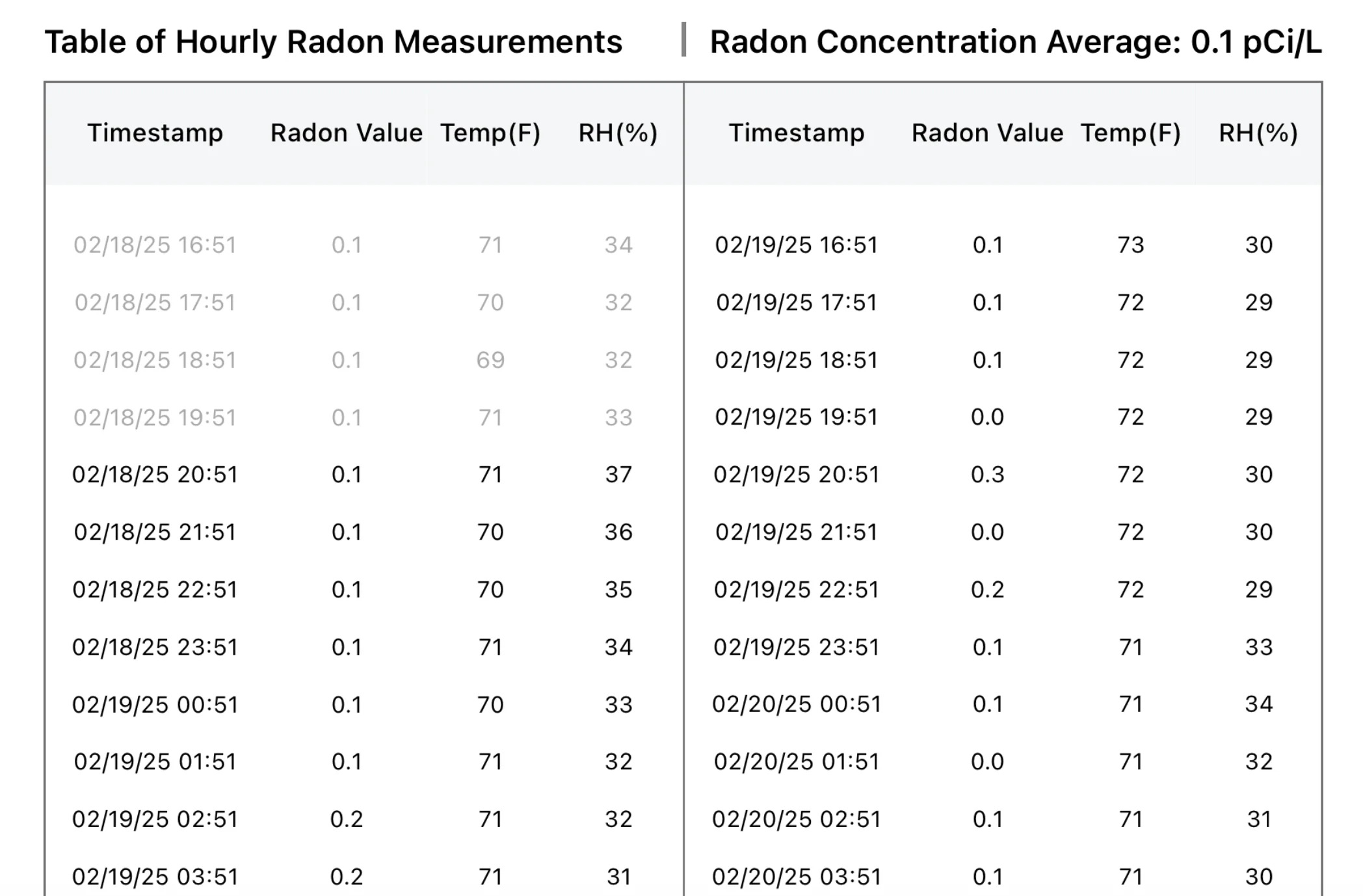
A continuous radon monitor logs hourly readings on the lowest occupied level for at least 48 hours, producing an average and a chart.
Every Home Spectors radon test follows EPA testing protocols and the North Carolina Radon Program’s guidance. It is a measurement service, not a mitigation contract.
Why radon testing during a home purchase
Even homes in EPA-designated lower-risk zones can test high. Zone classification is a predictive average. It is not a guarantee for a specific house. A short-term test during your inspection window gives you the result before you close.
A 48-hour deployment slots into most due-diligence periods without holding up your closing timeline.
The EPA maps counties by zone (1 highest, 3 lowest) as a predictive tool. Individual homes in any zone can test above the action level.
Test data lets you negotiate mitigation, plan post-close remediation, or move ahead confidently — with a real reading, not a guess.
Independent testing — we do not sell mitigation
We place a continuous radon monitor on the lowest occupied level of the home. It runs for at least 48 hours under closed-house conditions. This is our standard protocol. The EPA range for short-term testing is 2 to 90 days, depending on the device.
We do not perform radon mitigation. Our reading is independent of any remediation sale. It is a straight number in a written report.
- Continuous-monitor short-term test (48h+)
- Lowest occupied level placement
- Written report with the raw reading and EPA action-level context
- Referral to independent NC-licensed mitigators if warranted
- Install radon-mitigation systems
- Sell mitigation contracts
- Refer to a single preferred mitigator (independence rule)
Three steps, one honest reading
We confirm the timeline and coordinate with your general home inspection. If your due-diligence window is tight, we place radon on the same visit. Nothing waits on us.
We place a continuous radon monitor on the lowest occupied level for at least 48 hours under closed-house conditions. Windows and exterior doors stay closed except for normal entry and exit.
We retrieve the monitor and process the reading. You get a written report with the raw data and EPA action-level context (4.0 pCi/L). If the reading warrants mitigation, next-step guidance is included.
A written report, the raw data, and next-step guidance
You get a written report with the raw radon reading and EPA action-level context. If the result is at or above 4.0 pCi/L, we include next-step guidance.
We do not sell mitigation. If your reading warrants remediation, we refer you to independent NC-licensed mitigators. You can shop for a fair quote with no pressure from your tester.
Hourly readings and the 48h+ average — the actual monitor output.
Where your reading falls relative to the 4.0 pCi/L action level, in plain English.
If mitigation is warranted, we refer to independent NC-licensed mitigators — never a single preferred vendor.
Radon results are delivered on the Spectora platform, attached to your Home Spectors residential inspection report. See what the deliverable looks like:
Open a Sample ReportFOR AGENTS
Radon during a real-estate transaction
Radon testing is commonly added to a home-inspection contingency in the Triad. A short-term test runs at least 48 hours under closed-house conditions. Schedule the test window with the listing agent. That way occupants and showings do not disturb the monitor.
The radon reading is attached to the residential inspection report on Spectora. Your client and cooperating agents see everything in one package. We do not sell mitigation. That makes the reading a neutral input for your negotiation.
Radon testing — questions we hear
What does the EPA action level of 4.0 pCi/L mean?
How is radon zone risk determined in North Carolina?
Should I test if my county is in a lower-radon zone?
What is the difference between testing and mitigation?
How long does a radon test take?
Is radon testing typically part of a home purchase?
What if my reading is at or above 4.0 pCi/L?
Bundle testing on the same visit
Same inspector, one visit, one coordinated report. These environmental and specialty tests commonly bundle with radon:
Air and surface sampling with third-party lab analysis. Written report with next-step guidance — we do not perform remediation.
NC state Wood-Destroying Insect Report form. Commonly requested by NC lenders on real-estate transactions.
State-recommended panel for private wells — bacteria, nitrates, metals, and (on request) VOCs.
Pre-drywall and final walkthrough inspections for new-build purchases in the Triad.
08 · WHAT IT COSTS
What radon testing costs
Radon testing pricing depends on the size of the home. It also depends on whether we perform the test alongside a home inspection or as a standalone service. You will see the exact price in the scheduler before you confirm.
We do not charge for the follow-up conversation if your reading is elevated. If you want help reading the result, we walk you through it. Because we do not sell mitigation, the referral to independent NC contractors is at no cost.
09 · SERVING
Serving Greensboro, the Triad, and surrounding communities
Home Spectors performs radon testing across Greensboro, Winston-Salem, High Point, Kernersville, Burlington, and the surrounding Piedmont Triad. If you are outside this immediate area, call (336) 382-7269 and we will confirm coverage before you book.
Ready to schedule radon testing?
Independent test, written report, EPA action-level context. Family-owned in Greensboro since 2007 · 4.9★ on Google · 40,000+ inspections.